Sunday, March 13, 2011

Bare Feet and Jandals

We have moved to the village of Lalomanu on the south coast of Upolu, the main island of Samoa. We have settled into the Samoan way of life, breakfast at 9, or maybe 10, beach and swim till 1 or maybe 3, then have our afternoon beer and a sandwich, bake till 5 and then out of our swimming gear and bare feet and into our short pants and tees and jandals for supper at 7 or maybe 8:30 ( whenever the kitchen staff get it served ). The staff set up the tables family style and then set out all the dishes, every one helps themselves - kind of like the old farm crews did. We never know what will be served but it is always good and always more than enough to eat! Samoans are pretty laid back and while I adjusted well, Loreen took a couple of days to get out of the swing or into it! Jandals?, these are the rubber sandals, the Aussies call them thongs, we call them flip flops and the Kiwis and Samoans call them Jandals. Thongs, as I know them are those skimpy little bikini bottoms that have no seat, I guess there are a couple of girls here from Argentina that are wearing thongs, at least that is what Loreen told me, I didn't notice!

Lalomanu Beach

This area of the coast, although very beautiful, suffered a tragic tsunami in September 2009. I am not sure what the total death toll was or the total damage, but as you drive through the villages along the coast there are still many destroyed homes and buildings. We went into three separate resorts where the restoration is still underway from the the destruction caused by the Tsunami.

Beach Fale, rent by the day or by the night.
The villages, like elsewhere in the world, some appear to be poorer than others, usually consist of two or three churches, two or three small stores were you walk up and order over the counter a limited supply of goods, and houses of varying style. The most common and traditional type of house is a fale - an open structure with a flat concrete or wooden base, six or eight upright beams down the length and then a thatched roof over all. Most have plastic tarpaulins that they drop down at night for privacy or when it is raining. There is a smaller similar structure along side where the cooking etc, is done. Some have furniture (foam mattresses, a few chairs) and others don't, maybe a few chairs outside. Then next door there could be a wooden framed or concrete block house complete with doors and windows.

Samoan House

 The village we are staying in seems to be richer than some others we drove through as there are mostly fully enclosed structures and even those that are open type structures have a walled off room or up to half of the building built into enclosed rooms. I have not seen any laundry facilities out in the villages, although we did see some ladies washing clothes in the creek, but the people always look clean and refreshed and have the biggest, whitest smiles.

More Modern

Churches are a huge thing here and the families of the villages provide everything for the pastors, a nice house, all the meals and usually enough money that the pastors children can go to private school overseas (ie New Zealand) even though some of the families can not buy school uniforms for their own children to go school. People are expected to contribute at the Sunday service and the amount each family gives is shouted out to the congregation putting extra strain on the poor families as it is a matter of pride to be able to contribute at least as much as your neighbor. This pattern is starting to change as Samoans that have worked overseas for years are coming home and saying, no, my home and family will come before the church.

There is no hunger in the villages as each family has a piece of land and grows their own food. One of the family members, Star, walked us through their plantation yesterday. They grow coconut, banana, various types of taro, (a root vegetable), yams, sweet potato, papaya, breadfruit, onions and some other western veggies. We had gone to their out door kitchen area where he and two other fellows were cooking an umu for our lunch. Now umu is not an exotic type of animal but their term for a traditional underground oven. They built a fire, covered the coals with rock, laid in a suckling pig, some chickens, some fresh fish, taro, yams etc. Then it was all covered with wet banana leaf and more rock. Four hours later, scrumptious.

Star also treated us to a coconut demonstration, where he husked a coconut, cracked the top off with a machete, and let us drink the water. Tasty, he then sat down and grated one half, took the other half and shaved out chunks and let us try both of those. Again, fresh coconut is very good, rich and creamy.


His cousin, Bati, then climbed a coconut tree and brought down some green coconut for us to try, these are full to the top of sweet coconut water. Bati, is pretty skilled up the tree, like a monkey, and when he had the husks removed, he simply banged the top of the coconut three times with another one and behold there was our drinking cup.


Bati

The coconut is called the survival tree, as it provides all a person needs to survive, while the banana is called the Samoan vending machine, as it always has some ripe fruit. Loreen walks out into the plantation every day and finds us a fresh papaya, she is a good provider!

I may try out for a rally car driver after driving in Samoa as pigs and chickens free range through the yards, the neighbors yards, the road edges, etc. You always see at least a hen and her chicks or a sow and a bunch of piglets sauntering across the road in front of your vehicle. So between dodging potholes, kids, pigs, chickens and the odd drunk Samoan man weaving down the centerline, where they exist, I think I could qualify. And, do not believe that 50km limitation on those small doughnut spare tires that come with new cars. We rented a car and drove across from one side of the island to the other, only to have a tire separate. None of the locals were to concerned, they could maybe get us fixed up in a couple of days! When I phoned the rental place, it was "Oh just drive the car back into Apia and we will look after you". On the small spare tire, oh sure! So away we went, through pot holes, around pigs, chickens and little ones and 2.5 hours later, there we were at the rental place. Simple fix, they just parked that car and gave us a new one. It seems that driving on these small spares is commonplace here - up to three or four weeks in some cases. 


We are staying at Taufua Beach Fales, a place that was mostly destroyed during the tsunami and has rebuilt over the past year. At least one lady from New Zealand died and the family that owns the resort lost twelve family members, from young children to seniors. This is an extended family where two or three brothers and sisters are involved in the business and the tragedy was spread across all their families. They lost the resort, the family home and 12 family members.

Despite the family and property loss the family has rebuilt their resort at the same site. I use the term resort loosely, as it consists of a closed kitchen, open eating area and combined bar. There are about 12 beach fales that are open structures with tarpaulins to drop at night for privacy. The backpackers traveling through seem to like these. They also have 8 walled fales with locking doors, none have bathrooms, there are communal showers and toilets, cold water only. Now I had quite a struggle convincing Loreen to stay in this resort, even in a locking fale, due to no hot water. But after checking out a number of other places, most that were more expensive, even more simple and basic, and only providing breakfast, this place serves two meals per day, we decided this was the best. We did compromise and picked up an electric kettle and a wash basin before we left town, which works good for shaving and washing our faces and hair. Cold showers here are not really that cold.

They did move the family home high up the mountain through the village and have added 10 tourist bungalows at the mountain site complete with their own cold water ensuites. That is where we are, it is quieter (we are the only guests up here) and the views out over the ocean are exquisite. We look out through a few coconut and papaya trees at a couple of small uninhabited off shore islands, one a previous leper colony, and then an endless blue sea. Scattered down over the hill are the roofs of a few village houses which add to the ambience and colourfull view. We drive down to breakfast and dinner, swimming, sunbathing and socializing every day. The island is mostly surrounded by coral reef and these create large lagoons between the reef and the beaches, the water in the lagoon is bath tub warm and salty enough that even I can float! The ocean crashes against the reef with large breaker waves and thunderous sounds, but the lagoons are quite calm. The drive back at night is a little like an obstruction course, as the locals mostly stay out of the sun during the hottest parts of the day and come out in droves at night, socializing seems like the nightly recreation.

Our Bungalow
The clientele at the fales is an international affair, with folks staying anywhere from over night to six months. The short term people are usually Kiwis on a week trip or backpackers passing through. The gathering of long term guests include a Canadian (3 months), an Aussie (3 months) a German lady (6 weeks), three Norwegian girls (6 months, they all have Samoan boyfriends) and an Italian man (with no arms) who is like part of the family. Visiting with this group results in some really good stories.

As we left this beach fale this morning the owner came and gave us money to buy Samoan souvenirs with and the manager and head bartender/accountant came out and hugged us and sent us on our way with good wishes, it felt like when you leave friends or relatives places.

Saying Goodbye

Churches, dogs and roosters

Somoan Sunrise
This is the third south pacific island we have visited and I doubt there is any place in the world that has as high of ratio of churches to population as the South Pacific. However, by the amount we have seen in our first two days here, Samoa has more than either the Cooks or Fiji.


I had also forgotten about the dogs and roosters. Most families have a dog or six and flocks of chickens free range in the yard. Dogs, being dogs, sleep all day and prowl and bark all night. Our first night here we knew we were going to be serenaded by the neighbors roosters as it was practicing in the evening for the morning wake call, so we were kind of prepared for that.

But the dogs, they started trying out for a choir about midnight and finally got into entertainment mode with a full choir about 3:30 in the morning. What a clamor, it got so loud it woke up the rooster and he joined in for about 10 minutes, then I guess he figured out it was still pitch black out and went back to sleep. The performance ended in about an hour, except for one lonely dog that kept trying to get it revived, finally even it quit. Thankfully, after his night song, the rooster slept in until about 6:15, when he was woken up by his brother down the street. So the next night we dug out our handy dandy construction type ear plugs and slept the night away!

We stayed for three nights in Apia (population of 37,000 and the only city on the islands) in a bed and breakfast. It is a converted family home with twelve pretty basic bedrooms, some with ensuite some without. We spent our days wandering the city seeing the sites and figuring out where to go for the beach portion of our time in Samoa. Apia, as a town, encompasses about 40 local villages, these are still identified as villages. Each family within the villages elects it's own matai or chief, and these in turn elect the village matai. All village decisions have to made by a gathering of all the family chiefs, and the head chief makes the final decision based upon the highest support of the family matais. This extends to the decisions for the city of Apia.

We went to Aggie Grey's, the fanciest hotel in town, on the last night for a Samoan buffet and cultural dancing and singing. The meal was huge, salads, chicken, ham, pork, turkey, beef curry, desserts and some raw Samoan fish dishes. We both pigged out and even managed to find a bottle of New Zealand Sauvignon Blanc to accompany the meal.


The Samoan singing and dancing is more Hawaiian style than Maori style. The ladies are very graceful and do a lot of the dance with their hands to add expression to their dances. Maori men have an "in your face" warrior type of dancing, whereas the Samoan warrior dances are more refined and instead of severe facial expressions they do a lot of body slapping and foot stomping. The singers and dancers were backed up by a couple of drummers and half a dozen guitar players. The drums, usually just a hollowed out log of various sizes, can produce a number of notes on the musical scale through the varying lengths and thickness.


The hotel is named after the original owner, Aggie Grey, a Samoan lady married to an Englishman, who started the business in 1942 selling hamburgers and coffee to US servicemen who were in Samoa on leave. Then she started a boarding house that has now become two high-end resorts. Her great granddaughter, also named Aggie Grey, always performs the last dance of the evening.

Aggie Grey


Somoa has a population of 136,000 on the island of Upolu and another 40,000 on the island of Savai'i with more Samoans now living offshore than on the islands. Mostly in the US, Australia and New Zealand. At one time fish and tropical produce such as bananas, coconut, and coffee were expected to become big export earners but this did not happen. Also, at one time exports covered 60% of their imports from New Zealand and other south pacific destinations. Today that has declined to under 2%. There is no industry and little opportunity for economic development.

The minimum wage in Samoa is about $0.84 CDN per hour and lots of Samoan families live on remittances sent home from family over seas and/or subsistence farming. The biggest employer is the tourist industry, but even that is small and in its infancy compared to Fiji, Tahiti and the Cook Islands. The country is beautiful and the people friendly so I am sure that with time and investment Samoa will become a tourist destination, should the people here want it to.

Wednesday, March 2, 2011

On the Road Again

This has become our theme song while in New Zealand, every day that we head off to another town or beach in the camper van one of us sings "On the Road Again". This time for the last little journey before leaving NZ.

Getting through Auckland was very easy, no roundabouts and no traffic lights, Hamilton though was a bit more complicated. It seemed like we changed direction from north to west and then back to north about five times, went through 13 to 15 roundabouts and a few sets of lights. Our friend, whom lives north of Auckland and drove truck here for twenty plus years, says Hamilton is a nightmare even for Kiwis to get through, but it is well signed and we really had no problems.

Going through Auckland, the motorway just goes from a one lane to a three lane freeway through the city. Speed limit of 100kms and every one including big trucks travel at that speed. I stayed in the middle lane and stayed up to the vehicle in front of me. The drive did have its moments. The lanes are narrower here than at home and at one point Loreen was leaning over so far her head was almost on my knee, now I was used to her doing that on the mountain roads, but not on the motorways. A semi was passing us in the left lane and when she recovered she said "Oh my God, I could have reached out and touched that truck, it was so close". Then a bit later she said to me, "What a pretty view, no don't look I will just describe it to you"! At that point we were going past the marina and the sail boat masts where in the hundreds, which is why Auckland is called the city of sails.

Auckland, has large bays on both sides of the city and it is only a very small piece of land between the Tasman Sea and the Pacific Ocean. There are numerous marinas and the highest amount of sailboats per capita of any city in the world.

Surprisingly, 30kms north of Auckland we were back down to one lane motorways and almost immediately back into the mountain and sea shore roads.

Again, we were taken in by the scenery and the beaches.


We went to Waipu on Bream Bay with sand beaches forever and no one on them. We were there Thursday and Friday and on Friday a few families and some surfer dudes showed up, but pretty vacant compared to the beaches on the west coast of North America.


We spent most of Saturday in Managawhai where our Kiwi friends live and they hosted a barbecue for us and the neighbors. It was very nice, good food and great people. It was here that I kind of got my head around Kiwi's and their beaches. One of the neighbors was a Brit who had moved to NZ in the seventies and he said, "We have so many miles of nice beaches here that we just take them for granted, not like Europe or other parts of the world. No matter where you live in NZ you can be on a pristine sand beach in a few hours".


So our Kiwi adventure draws to a close, and we have missed so much. We seen a lot and never stayed in any one place more than three nights, but there is just so much more to see here. This is a "return to country", but would need to come for a few months to see it all.


Samoa here we come!

Friday, February 25, 2011

Rotorua

We were traveling from Hawkes Bay to Rotorua when the unfortunate city of Christchurch was struck by the earthquake on February 22. Our hearts go out to them.

Just when you think you have seen the best, most awesome, whatever expression you want to use, New Zealand comes up with another awesome place. Rotorua is such a place, probably not better than some other places but definitely a must see if you ever travel to New Zealand.

Rotorua town and the lake are set in the center of a large volcanic bowl. You can stand on the lookout tower in the museum and see the edges of the crater bowl above the town on all sides. There is a belt through NZ North Island that has 17 thermal zones, including two thermal power plants that contribute five percent of NZ's power. At first I thought the cooling tower of a thermal plant was a nuclear plant and was confused as I did not think NZ had nuclear power. Then I thought maybe thermal which I later was able to confirm. A pretty neat and green way to produce power.


The area is on top of huge geothermal pools and as you drive into and out of the town you can observe spouts of steam coming up from the ground through the fissures into the hot underground water sources.

Originally settled by the Maori, British missionaries moved to the area in 1843 and established a mission which grew to a village in the vicinity of the white and pink terraces. These terraces were formed by thermal water draining down the side of the mountain and solidifying into descending pools deep enough for people to bath in. The white and pink colors came from the type of minerals in the water. Pictures of the two terraces show one a brilliant white and the other a salmon pink. The terraces were proclaimed to be the eight natural wonder of the world.

The local Maori tribe collected great amounts of money from European tourists that led to increased illness and alcoholism amongst them. One of the tribes priest warned of coming disaster and around June 1st 1885 a group of tourists and their Maori guide seen a ghost canoe of Maori on the lake leading to the terraces. Ten days later Tarawera Mountain erupted and the flow of basalt magna and mud completely buried two Moria villages, destroyed the British settlement and buried the white and pink terraces forever.

Even after this tragedy people continued to move into the Rotorua area and make use of the thermal water for medicinal and bathing purposes. As early as 1878 people with arthritis were brought to the area for immersion in the waters. One of the pools later became known as the "Priest Pool" after a Catholic priest, disabled with arthritis, who was able to walk home to his Parrish after treatment in the pool. Successive baths were built in the area and two bath houses remain, the Blue Baths and the Bath House. The Blue Baths built in the 1930s house swimming pools and event rooms for weddings etc.

The Bath House was built in the early 1900s as a sanatarium and health spa to use the hot mineral waters. The bath house was used to treat various ailments including arthritis, rheumatism, nervous disorders, psoriasis. The spas were also used as a rehabilitative hospital for wounded soldiers returning from World War II. Due to the high acidic content of the waters maintenance was and costly and the medicinal effects of the waters was called into question by health authorities, the money generated by the tourist trade was not able to keep the Bath House maintained.

The Bath House has been restored and now houses the Rotorua Museum. The museum houses and tells the story of the Bath House, Maori settlement and culture of the area and the Maori Battalion that fought with distinction and high losses during World War II.

Museum, formerly the Bath House


The Battalion was formed by the Maori themselves and all that joined were volunteers. Many families saw all their sons join, some as young as 16. They fought in Greece, with great defeat and then were shipped to Africa, where faced with charging a German line, one of them led the way with a Maori battle song. They won the line and and with continued reinforcement from the Maori back home fought with distinction in North Africa and Italy. The losses were extremely high, one in six were lost, and many of the interviewees expressed that some of the problems that the Maoris have experienced with later generations are the result of that group of men not being there to guide the younger generations.

The next day we visited the thermal wonderland of Wai-O-Tapu, (Sacred Waters in English), a very diverse and beautiful area of thermal activity. A three kilometer walk takes you through hot springs, hot pools, newly formed terraces and other thermal activity. Wai-O-Tapu sits on the edge of a volcanic caldera.

First on the agenda was Lady Knox Geyser, which with some help erupts every morning at 10:15. Without help, the Lady erupts between twelve and seventy hours. Under the geyser is cold water over laying extremely hot, 100 degree celsius, water that eventually heats up the surface tension of the cold water level, which then beaks and allows the hot water and steam to erupt. The geyser was originally discovered by penitentiary inmates on a tree planting work gang. Deciding to wash their clothes they used carbolic soap in the hot pool and the soapy water draining underground broke the surface tension causing the geyser to erupt. Today for the show they dump down a bit of surficant and within about 5 minutes Lady Knox explodes, up to twenty meters in height and can last for twenty minutes. Over time the silica in the water has hardened and formed the mound that they drop the surficant down.

Geezer at the Geyser


The walk itself wanders around and through the thermal pools and cavities that have fallen in from the erosion of the fissure walls from corrosive and acidic waters. Many of the pools are filled with colored water from all the different minerals contained in the water.


Colors run from rust through shades of yellow and green.


Also forming is another smaller set of terraces from the spill of the biggest pool. It was a very informative and mind opening walk which you can tell, I was quite taken with! We also went to see the boiling mud pools.


Then off to a Maori village for a cultural show. There are many hotels in Rotorua that have Maori shows and two family villages where they put on a cultural show and treat you to a "hangi" traditionally cooked meal. The one family village belongs to a family that as young men they ran afoul of the law a lot. The brothers decided to reform and built a thriving business around the village and performing for the public. Seven shows a week that are usually sold out.

The Maori cooked all their food in ground pits. First they build a fire of wood and then line the embers with river rock, when the rock is white hot in goes the food wrapped in wet leaves and matting. Then they cover all with dirt and let steam for a couple of hours, then they dig it out and consume. I remember my Dad cooking a side of beef for a community picnic similar to this on the sand flats at East Pine when I was a kid.


They are a little more modern as the fire is propane fired and the the food is all put into big steel pans and then covered with moist cloths and steel oven lids. Nor was the food traditional as it was lamb, chicken, potatoes, kumara and lots of salads. Kumara, red sweet potato, was the only traditional Maori food of the evening, but it still was yummy good.

The warriors greeted us by paddling a war canoe down a small stream that transects their family lands. All had facial tattoos and performed wonders with the canoe, paddling forward, backwards and side ways across the creek at will.


Next we went into the village to be greeted by the Chief and welcomed to their world. There were 10 male performers and 4 ladies, yes the ladies also had facial tattoos.


All Maori tattoo patterns tell a story, lineage, deeds, etc., and for Maori of different tribes or non-Maori to copy them is insulting. To stop copying of their tattoos, the Maori have developed tattoo patterns based on Maori lore that have no tribal or mythical Maori meaning. These are the ones that are sold in the tattoo shops. Loreen threatened to throw a hussy fit when I wanted to get a warrior tattoo over my right eye. Not sure why she got so excited. I thought one similar to this would look nice!

I liked the tat on the middle guy


They performed a number of dances, songs and demonstrated the use of their weapons. A lot of the dances performed were built around a warrior society and developed as way to exercise muscles and joints to handle weapons. Dances at the performance last minutes but in fighting times would last up to 30 or 40 minutes at a time for strengthening and building flexibility. Lastly they performed the tribal "haka" war dance where they bulge out the eyes, stick out the tongue and generally scare the hell out of you if you had to face them in a battle. The chief explained a lot of their myths and how the Maori formed the two islands of New Zealand.

Haka


Then off to the "hangi" where we feasted and drank wine - imagine that, Loreen and I drinking wine! All in all a very pleasant and entertaining evening. We are off from Rotorua in the morning for our next big adventure, me driving through Auckland, city of 1.2 million, looking for traffic signs and going through three and four lane traffic circles. Woo hoo!

Hawkes Bay

We caught the Interislander ferry to the north island and spent three nights in the Hawkes Bay area. Hawkes Bay itself is a beautiful Pacific Ocean bay that is anchored by the city of Napier. This leads out to a huge agricultural area (vineyards, fruit trees, market gardens, dairy, sheep, and the list goes on) that runs through and past the city of Hastings to the bottom of a high mountain range that leads back to the port at Wellington. 

I know I have talked about NZ mountain roads before, but the mountain pass from Wellington to Hastings was the worst so far. Steep grades, 70 and 80 percent side slopes, endless curves and barbed wire guard rails for 26 kms.


Loreen said this stretch of road makes the Rogers Pass look like it is on the prairies! New Zealanders, when I make some idiotic statement like, "that sure is a tough piece of road", they always tell me, "oh that road is really good compared to some other places"! They are a patient bunch, as at times I or other camper vans have had up to ten cars behind us, they just wait for a passing lane and away they go. I get a kick out of the curve sign that says "25kms" while right beside it is the 100km speed limit sign.


Schools on the motorways put up signs to thank drivers for not exceeding the 100km speed limit while within the school zone! Oh yes, and pedestrians have "NO right of way". I am adjusting well to all the rules of the road while driving (i.e. driving on the left, the mountain roads, strange road rules, etc.), with the exception of being a pedestrian and trying to cross streets or roads. The only place a pedestrian has the right of way is at light controlled intersections and other than that pedestrians have to "give way" to all vehicles. We read in the paper yesterday of two separate accidents in Wellington where tourists were hit by bus drivers on "uncontrolled" cross walks! Crazy!

I digress, one of the reasons we went to Hawkes Bay was to visit the north island wine region and one of Loreen's favorite Kiwi wineries, Kim Crawford Wines. After picking up a winery guide in Hastings, we find a winery called Te Awanga, formerly site of Kim Crawford wines. Unlike Oyster Bay winery, Loreen's second favorite Kiwi wine and also a must see, Te Awanga at least had a tasting room. We found out that Oyster Bay in the Marlborough Valley has no tasting room. So off to Te Awanga we go to find out what has happened to Kim Crawford wines.

Similar to Oyster Bay, Kim Crawford has been bought out by an international corporate company that has a multitude of alcohol brands all over the world. They have kept the Kim Crawford name and still market wine under that brand, but the wines are no longer made as they were in the past (at a private winery with Kim Crawford being the winemaker) but are now part of a long line of Kim Crawford vintages, some of which are certainly no longer to our taste! Oyster Bay has met a similar fate and although the company still owns the original Oyster Bay vineyards, the original Kim Crawford vineyard is now owned by Te Awanga. Te Awanga has some very, very good wines of their own, but as a small batch winery they do not export to Canada. So sad!

Loreen at Te Awanga, formerly Kim Crawford Wines


Then we were off to Napier where we visited a couple more wineries.


We visited another Catholic sect that had started the vineyard for sacramental wine and then progressed to a corporate entity. We thought we might have lunch there and were quite perplexed at the amount of people in the car park dressed in 1920 and 1930 style. There are numerous dress and antique shops in the downtown that specialize in flapper dresses, hats and 1920 style suits. You can also buy this type of clothing in almost any shop except for the brand name and department type stores.


Napier was destroyed by an earthquake in 1931and was reconstructed in a 1930's style of Art Deco architecture - both the downtown business and residential districts. An art deco celebration is held every year, where people from all over the world come and spend the four day festival in dress of the thirties. They have a large antique car rally and it is strange for me to see a 1957 Ford or Chrysler driving down the road with right hand drive.


We met two really nice New Zealand couples at the campground so we spent a lot of our time visiting and just relaxing. We have seen some special places in NZ and this is just another. The climate in the north island seems similar to San Diego, with little difference throughout the year. Warm, but not overly hot during the days, low humidity and warm nights. Beautiful scenery, great climate, maybe a place to spend our winters on the ocean!

Monday, February 21, 2011

Picton

Picton is where you catch the ferry on the South Island to sail off to Wellington on the North Island.

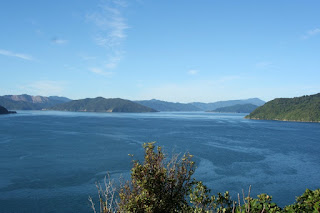
Picton is situated in a harbor off Queen Charlotte Sound and is one of the cutest towns (Loreen's term, and I totally agree) we have encountered. It is not an industrial port, it handles the trucks and containers that come across on the ferry from the north island and gets about three cruise ships a month. Consequently it has grown up as a bit of a tourist town and all the downtown streets end at the wharf. The wharf itself is full of little pubs, restaurants, small retail stores and tour companies. There was a junior sailing regatta taking place as we left the wharf, with these little boats going, to me, around in circles.


 The north end of the south island is all sounds while the south end is all fjords. Being an inquisitive type I asked what the difference was. Fjords are caused by glacial gouging and movement while sounds are old river valleys. The total north east end of the south island was at one time inland lakes and rivers that have sank and been flooded by the ocean

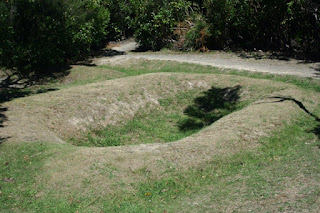
We visited a Maori "pa", which is a high piece of land that was supposedly easily defendable. This particular one was set on a high ridge with steep cliffs on three sides and a narrow strip of land into the main area. As there were no rats, etc, on NZ they simply dug ground pits in which to store enough food to last out a siege. This group was eventually wiped out by another band of Maori that had been supplied muskets by the British. No archaeology work has been done here and the site is maintained as it was found.

Food Storage Pit


We then followed the old foot path down to the beach where there were hundreds of black and purple mussels attached to the rocks along the shore line. Loreen, being ever enterprising, decided we should gather up a sack of these for our supper. I was pretty skeptical about it all, without asking a local if they were safe to eat or not. Loreen won out and what the heck you have to take some risks, so we gathered a dozen of the biggest and took them back to camp. After a good cleaning we steamed them open and then grilled them on the half shell with copious amounts of garlic and butter. Yum, yum, why do I ever doubt my wife!

Beach Mussells


Queen Charlotte Sound was named by Captain Cook after the Queen of England. Cook explored NZ from 1770 to 1777 and had favorite places in the sound where he would stop and replenish ship supplies and repair any damage. He established and claimed NZ as a British possession at a place now called Ships Cove. It is a sheltered cove with an abundance of fresh water and fish. Cook stopped there five times and planted fruit and vegetable gardens and off loaded sheep, pigs and chickens in the expectation that the plants would grow and animals multiply to provide food sources on subsequent trips. The Maori in the area, although friendly to Cook and his crews, must have been really happy every time he returned with another load of animals, as they ate all the vegetables and animals long before his return.

NZ has world class hiking and there is a 71km track along the ridge line of Queen Charlotte Sound. There is also a protected island just off Ships Cove where all predators have been removed. One must remember that NZ had no predators prior to European ships and the predators here now are hedgehogs, ferrets, possums, feral cats, etc, most brought by the English as pets and then let go into the wild. These animals have almost exterminated some NZ bird species, so this island was declared a protected area to recover the birds. Not active birders, we none the less, went out to the island to see some birds.

Weka, a NZ Flightless Bird


All though we did see a few birds the real treat was being able to just stop and listen to the songs from the bird choir. It was like listening to one of those tranquil CDs that they sell in some shops. There was also a viewing tower that was above the canopy and provided a 360 view of the sound.


Queen Charlotte Sound


After an hour on the island the boat returned and picked us up, took us across to Ships Cove and dropped us at the trail head of the Queen Charlotte track with the Captain informing us that if we made a 15 km hike to Furneaux Lodge, that the mail boat would be there in five hours and would take passengers back to Picton.

With the blisters mostly healed and feeling pretty smug about our last hike, we spent 30 minutes looking at all the memorials and information boards about Captain Cook and his voyages, then set off for the lodge. The first 2.25 kms was a 200 meter ascend to the top of the ridge and then another 2.25 kms back to sea level. The last 10.5 kms was a bit easier but still had many ascends and descends. We stopped twice to snack and made the hike in four hours, and even though the last kilometer was flat it seemed as hard as the first 2.25 kms. So with a half hour to spare we had a lay down on the beach and waited for the mail boat. They must have delivered a lot of mail that day as it was about forty minutes late, but it also picks up passengers and delivered us safe and sound back to Picton.

The Mail Boat


After a Kilkenny, a Connemara, fish and chips and cottage pie, (not shepherds as shepherds pie has to be made with lamb and this was made with beef), we limped off to our trusty little home on wheels in preparation of crossing Cook Straight to the North Island. Well Loreen had the Kilkenny and fish and chips, I didn't have it all!

Sunday, February 20, 2011

Blisters and Scrapes

Loreen and I have spent the last few days doing some more "physical" adventures.

We travelled up to the north west to Abel Tasman National Park. It was not a long drive from Kaikoura, but it took a full day as we traversed a few mountains and then went through the cities of Nelson and Richmond and the town of Stoke. Although there is a bypass road that misses all of them, we missed it on the way to the park but found it on the way back! Oh well, I got to practice my driving skills around a half dozen more traffic circles and practice is good.

We camped at the beach town of Kaiteriteri, a nice place with a 400 plus camp ground. It is very popular with the Kiwis, in fact it is full of folks that come there every year for their summer vacation. They set up almost permanent camps sites. Caravans (trailers) complete with canopies, that make into a tent thus giving them another full room, plus add on sunscreen and/or cooking areas. Loreen talked to one lady who has been coming there every year since she was a little girl and has just carried on through married life for some forty years.

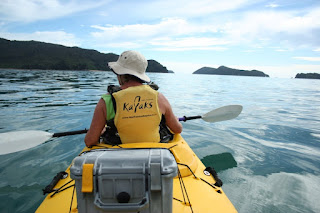
We were off the next day on a sea kayak adventure. Now I have kayaked once before and this was Loreen's first time, so did we pick the half hour excursion around Kaiteriteri bay? No, instead we drove over the mountain, well I guess just the headlands on the ocean to Marahau (5 km that took 30 minutes) and set out on a 3.5 hour kayak trip along the bays and headlands of Abel Tasman park. We had a great guide that kept us informed of how all the little beaches got their names and how the lady that owned the land, that the park is now on, manipulated the government into making the area a park. It seems the NZ government, even though she was donating the land, had no desire to establish a park there. So, because Tasman the explorer from Holland was the first European to find NZ, she simply asked the Royal Dutch family to come over and open the park, which they accepted. When the NZ government was informed that the royal family was coming to open a park they found it a priority to make the area into a park


There was a couple from Oz, a couple from Minnesota and a young fellow from Germany on the trip with us. The area is beautiful with high ocean cliffs interspersed with numerous open sand beaches. The sea was calm, the company good and scenery stunning. We did not see any marine life other than a multitude of birds. The guide showed us one sea bird that nests in the trees. Now landing in a tree nest with large webbed feet is not that easy, consequently these birds do a lot of rebuilding through out the nesting periods. They also have a unique way of moving the young out, the Mom just decides one day that it is time for the young to leave and simply pushes them out of the nest. They either fly or fall into the ocean and swim.

Onshore training


After about two hours of paddling around the headlands, I found I had developed a blister on my hand not that I admitted it to Loreen as she was not complaining, at the end of the trip the blister was gone, broke and drained, but sore. After a nice lunch on the beach, I found out Loreen's hands were not any tougher than mine were.

Loreen and Abel Tasman scenery


Now there are two ways to get back, either by sea taxi or walk. We opted to walk, but had not packed our hiking shoes but just wore our sandals. Up to this time we were thinking this was a 6 or 7 km hike and kept wondering why it was a 4.5 hour walk. So while everyone else is putting on their hiking shoes, we set off up the mountain in our trusty sandals (not your flip flops but good Tevas), after a fifteen minute hike to the top we see the direction sign back to town and wow it is a 14 km hike! The hike was great - walking along the top of the cliffs overlooking the ocean and the bays and beaches. The blisters from the Tevas put a little bit of a downer on it, but what the heck so far every thing was a long way from the heart, we just bucked up and carried on.

On the Abel Tasman Tramping Trail


Then off to the Marlbourgh Valley, which is the big NZ Sauvignon Blanc wine producing area. NZ is the largest producer of Sauvignon Blanc in the world, but the total NZ wine production is only 1% of the world production. I am guessing based on the comparative sizes of areas, the Okanagan would be less than half of one percent. The NZ motto is to produce quality not quantity as they can not compete with the large world wine producing areas, i.e. France, Italy, Chile, Argentina, Australia, South Africa and California.

We thought we would have to stay in Blenheim, about 15kms away from the majority of the wine tasting facilities we wanted to go to. This was bothersome as we really wanted to just park the van and bicycle from winery to winery, but the little town of Renwick, where the wineries are, did not have a campground. However, eagle eye Dan spied a little sign on a backpacker's hostel that said they had two spots for camper vans. In we went and sure enough they had a vacant spot. By the end of the evening they actually had four camper vans scattered around the property, two of us on power the other two not. When in campgrounds we always wash the dishes and shower in the campground facilities, which in most cases are separate sex. Not here, two shower rooms and both where unisex, they did have locking shower stalls! Even though I knew it could happen, I was still a bit shocked while shaving, to have a thirty something gal step out of the shower partially clothed and start to put her makeup on at the sink directly beside me. Why I had no choice but to grin and bear it!

The hostel also rented bikes, at half the price of elsewhere and they were good bikes, so off we go on a bicycle day trip to some wineries and for lunch. It was a tremendous day, we visited lots of nice places and learned a lot. The Kiwis are an exceptionally nice group of people, friendly and informative and most like Canadians. They all have been, have a friend that has been or want to visit Canada. Toronto, Vancouver, Whistler and the Rocky Mtn parks are the preferred locations.


Marlborough Valley


The valley itself is quite large and nestled between two ranges of mountains, forested on one side with lots of logging and grasses on the other with lots of cattle and sheep. In all very picturesque. So again we probably took on more day than we should have as we have not been riding that much on this trip, but we managed to do 25kms with stops. The last few kilometers was uphill and then into a brisk head wind. I had forgotten how a wind can effect you on a bike as I was down in the same gears as climbing hills. Anyway with my knees played out and the hostel in site, I looked back over my shoulder to see if the road was clear to cross, nope there was a car right behind me so I steered back out of his way and hit the six inch curb, first the front wheel, then the pedal on that side, then my knee on that side, then full length down the side walk. All in all, very graceful and entertaining for any that cared to enjoy the show. The young fellow walking down the sidewalk was quite concerned, especially when it seemed like it took five minutes for me to get up, I was fine and did not admit that my knees where so stiff I had to just take my time getting up! No serious damage, I left a patch of skin about 2 inches by 3 inches ground into the side walk, but the bike and the wine in the panniers that we had purchased were fine, and that was what counted. We had stopped at an orchard and picked a few kilo's of nectarines and they were a bit worse for wear. So those are the blisters and scrapes to date.

Before the wreck!


We are next off to Picton, to take a boat cruise and hike for a day on the Queen Charlotte trail and then the ferry to the north island.